|
|
College is one of the Constituent Colleges of the University of the
Punjab, dedicated to the Promotion of sound and enlightened study of Law.
The Law Classes are older than the University to which they are affiliated.
Started by the Anjuman-i-Punjab in 1868, they were taken over by the Punjab
University Law College in 1870. The courses of study extended over two
years, and instructions were given in two separate Classes, one in English
and the other in the Vernacular. No test was laid down for admissions; and
there were no examinations, as certificates awarded by the College possessed
little value. The Punjab Chief Court held its own examinations for Pleader
ship and admission to the Bar.
In 1873 rules were framed by the senate of the Punjab University requiring
the passing of Entrance Examination of some University or of the Punjab
University College as a condition of admission to the Law Classes. The
following year the Judges of the Chief Court conceded to the Punjab
University College the privilege for holding the Pleader ship Examination.
It was laid down that, with the exception of special cases allowed by the
Chief Court, no one would be admitted to the law Examination to the Law
Examination without having equivalent. The courses of study, as before,
extended over two years. Success in the First Examination qualified the
candidates for Mukhtarship, and success in the Second Examination qualified
him for Pleader ship of the subordinate Courts. Pleaders of five years'
standing could be admitted to the Chief Court Bar.
In 1885 the system of two annual examinations in the same subjects but the
higher standard in the second year, was replaced by a system of three
progressive examinations known as the Preliminary in Law, the First
Certificate in law, and the Licentiate in Law. From 1885 to 1906 the courses
of study extended over three years.
In 1887 the passing of the Intermediate Examination of the University was
made a condition for admission to the Law Classes. For the Licentiate in Law
Examination a candidate was required to be a graduate. Another regulation
provided that in order to appear in the examination, a candidate must have
attended three-fourth of the lectures delivered to his class.
In 1890, the Government of the India gave the University the power to confer
the degree of LL.B. and LL.D. The Law Faculty decided in 1891 that the LL.B.
Examination should be distinct from that of the Licentiate in Law, and that
it should be held in English only. From 1892 five examinations were held,
viz the Preliminary, the First Certificate, the Intermediate, the Licentiate
in Law and LL.B. To appear in the LL.B. Examination, the candidate or the
Licentiate in Law Examination. No one could be eligible for the Intermediate
Examination in Law without having passed the Preliminary Examination.
Passing of the Intermediate Examination in Law did not entitle a person to
legal practice. The courses of study extended over three years. The
candidates were, however, permitted to pursue Law and Arts studies
simultaneously. As a result of a conference between a Sub-Committee of the
Law faculty, and the Judges of the Chief Courts, the Licentiate in Law
examination was abolished in 1906, and the duration of the courses of study
for the LL.B. examination was reduced to two years. Mukhtarship (Vermicular
Class) was abolished in 1913.
Up to 1888 the teaching staff of the Law Classes consisted of a single Law
Lecturer. In that year two more members of the staff, Assistant Law Lecturer
and a Translator of Law books, were added. The teaching arrangements,
however, for a long time remained unsatisfactory. The weekly periods of
tuition for each class were not more than about four. In 1889 there were
five classes and five pat-time teachers. In 1903 the Law Classes were
designated "The Law College" and a whole-time Principal was appointed,
thereby raising the strength of the staff from 5 to 6. In 1909 the number of
the staff was reduced to three, all of them whole-time. This state of
affairs continued for the next six years. Since 1916 teaching staff has
included both whole-time and part-time teachers.
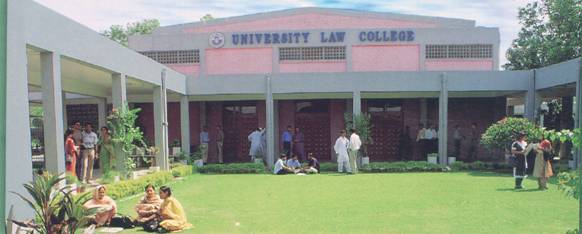
In 1922 the College was in the building on the Katchery Road. In 1978 the
College shifted to the present building at the Quaid-e-Azam Campus. The
building comprises of one College Hall, 12 lecture rooms, a Law Library, one
Moot Court Room, a Cafeteria and many other rooms for offices and various
other purposes.
In 1935 College Regulations were revised, and the course of instruction for
the LL.B. degree was again increased to three years. The rule came into
force as from the admissions made in 1936. In the Regulations were again
revised and the course of instruction for the LL.B. degree was reduced once
again from the two years. This rule into force at the beginning of the
1948-49 session. In order to provide facilities for people in service, it
was decided by the University to start evening classes, as an experimental
measure in 1956, which were discontinued with the end of the Academic
Session 1963-64, but were again started in 1966-67.
The Management of the College vests in the Law College Committee of the
Punjab University, subject to control by the Syndicate. Under the Statutes
of the University, the Law College Committee consists of the
Vice-Chancellor, the Dean Faculty of Law, the Principal of the Law College
and three other members.
In 1964 under the directions of the West Pakistan High Court, the LL.B
professional course was extended to three years. The College started
offering two degree courses in Law; B.L. (academic) a degree of two years
duration and LL.B. (Legume Baccalaurean) a degree of three years duration.
The holder of B.L. degree were eligible for admission to LL.B. degree only
within a period of three years from the date of their passing of the B.L.
Examination. The B.L. degree of a candidate who passed the LL.B. Examination
was to be deemed to have been merged in the new degree and therefore,
automatically cancelled. Under the rule of High Court of West Pakistan, only
the holder of LL.B. degree were eligible for enrolment as pleaders.
In November,1966, under the order of the Chancellor, the LL.B. course was
again reduced from three to two years. However, three years degree course
was re-introduced with effect from the Academic Session 1992-93.
Since the beginning of the Academic Sessions 1969-70 and 1970-71 regular
classes for Diploma in Taxation Laws and Diploma in Labour Laws respectively
were started. The Diploma in Intellectual Property Law was started from
Academic Session 1990-91. The admission to Diploma Classes is open normally
to Law Graduates but in exceptional cases the courses can also be undertaken
by the students of LL.B. Class. From Academic Session 1981-82 regular LL.M.
Classes were also introduced. The Ph.D. registration was made in 1986. Since
then three students have been awarded Ph.D degree in Law.
|


 University
Law College
University
Law College